TikTok is the new radio: What that means for your release
TikTok now drives more discovery than radio ever did. Here's how to turn content into streams without burning out.
The shift happened while you weren't looking
Goldman Sachs published a report in June 2022 that included a data point most artists scrolled past: music is central to 70% of all TikTok videos. More than a third of listeners who discover a track on TikTok go on to stream it on a DSP.
Short-form video now accounts for roughly 60% of emerging platform music revenue.
That's not supplemental. That's structural.
If you're still treating TikTok as a promotional add-on after your release goes live, you're using a 2018 playbook in a 2025 market.
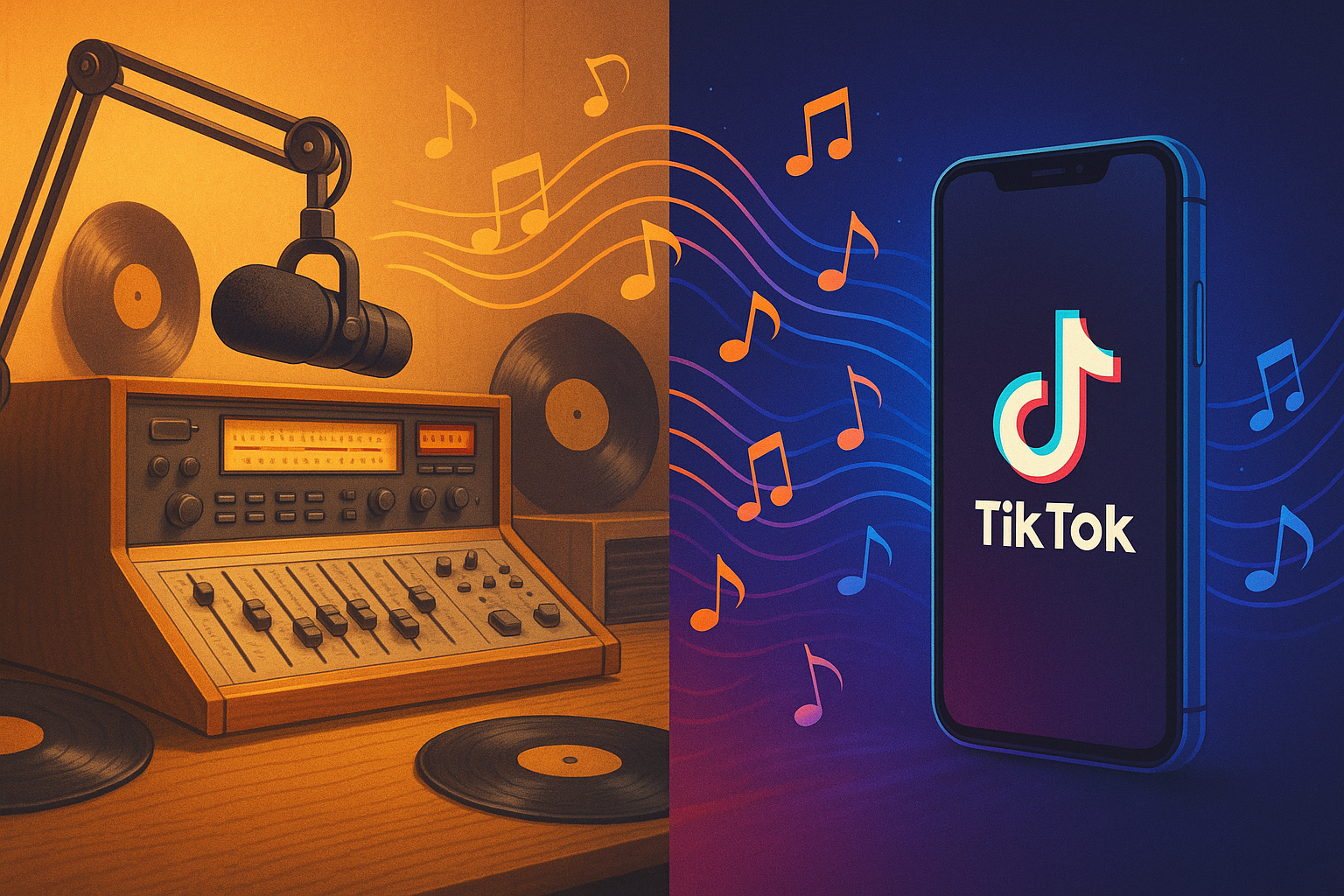
How TikTok functions like radio did in the 1980s
Radio in the 1980s was gatekept, programmed, and rotational. If a program director added your track to rotation, you got repeated exposure to the same audience over weeks. That repetition built familiarity. Familiarity built streams (or in that era, sales).
TikTok works the same way, but the gatekeeper is the algorithm, and the rotation is user-generated.
When your sound gets picked up in multiple videos, the platform reads that as a signal. It begins serving your track to more users. Those users create more videos. The cycle compounds.
But here's the difference: radio required a single lucky break. TikTok requires consistent output. You can't wait for lightning to strike. You need to create the conditions for it.
What the data says about content frequency and streaming uplift
Artists who post three to five times per week on TikTok see measurably higher streaming conversion than those who post once or twice. The reason is simple: more at-bats.
Every post is a test. Every test gives the algorithm more information about where your sound fits, who responds to it, and how it spreads.
If you post once and it doesn't connect, you've learned nothing. If you post fifteen times and three of them move, you've identified a pattern. You can double down.
The artists who break on TikTok aren't the ones who got lucky. They're the ones who posted enough to find the angle that worked, then repeated it until the platform noticed.
Content is the release strategy now
This is not about going viral. This is about treating content the same way you treat your catalogue: as an operational system that needs to run consistently.
Your release strategy used to be: finish the track, upload to distro, pitch for playlists, hope for adds.
Now it's: finish the track, build a content bank around it, release the content in sequence, monitor what moves, adjust, repeat.
The music is still the center. But the content is what puts it in front of ears.
If you're not producing content at the same pace you're producing music, you're under-distributing your own catalogue.
How to build a content engine without burning out
Most artists stall because they think every piece of content needs to be a creative event. It doesn't.
You need a system that produces output without requiring inspiration every time.
Here's how to structure it:
- Batch your content creation. Set aside two hours once a week. Record ten to fifteen short clips in one sitting. Film different angles, different settings, different snippets of the same track. Bank them.
- Create templates. Use the same visual structure, the same text overlay style, the same format. This isn't about being repetitive. It's about reducing decision fatigue. You're testing the sound, not reinventing the format every time.
- Use your AI content engine. Music Artist Manager's AI tooling generates caption ideas, video concepts, and format suggestions based on what's working in your genre right now. You're not guessing. You're building from data.
- Repurpose everything. A single sixty-second studio session can become six TikToks, three Reels, and two YouTube Shorts. One recording session, nine pieces of content.
- Track what works. Don't just post and hope. Watch which videos drive profile visits, which drive streams, which get saved. Double down on the ones that move.
This is not about being everywhere. It's about being consistent in the places that convert.
The Artists Who Win Are the Ones Who Treat This Like Infrastructure
You wouldn't release a track without clearing the splits. You wouldn't distribute without metadata. You wouldn't skip ISRC codes.
Content is the same. It's not optional. It's not extra. It's the distribution layer that determines whether your music gets heard.
The artists who are winning right now aren't the ones with the biggest budgets. They're the ones who built a repeatable system for getting their sound in front of the algorithm often enough that it starts working for them.
TikTok is radio. Your content library is your rotation. And if you're not programming it yourself, you're leaving your catalogue on the shelf.
Music Artist Manager's content engine helps you build that system without burning out. It's not about doing more. It's about doing it smarter.
Ready to streamline your workflow?
Stop piecing together spreadsheets and scattered notes. Join the waitlist for Music Artist Manager and get your entire rollout in one place.
Written By
Gavin Alexander
Senior Marketeer
As the founder of Music Artist Manager, Gavin has spent years at the intersection of music and technology. Seeing firsthand how chaotic release rollouts and split sheets can be, he designed a platform that brings major-label infrastructure to independent artists and their teams. He writes extensively about industry trends, artist leverage, and workflow optimisation.